
Book Review: Run Forever by Damian Hall

I remember a few years ago going to run the 100m at a local meet. I’d been doing it on occasion but mainly at masters’ athletics and this one was an open meet. I glanced along the start line of my heat as we took to the blocks and thought I should be in with a good shot. The gun went and the other seven took off on the b of the bang. I took off slightly later, but my stride length usually meant I could make up for my slow reaction times. By the half way mark I was third, and a moment after that second. There was only one person in front of me: a fifteen year old boy. I put the burners on and pushed for it, closing the gap with every stride. It wasn’t enough, he pipped me by a fraction of a second. I shook hands. And hung up my spikes for the last time.
Getting older in sports is interesting. The narrative built into society is that by our mid-thirties we’re past our best. By forty? You may as well give up entirely. In the not too recent past, I was even told by one doctor that I should think about giving up running for good and take up a pastime that was kinder on the body. Needless to say, I ignored them and changed GPs; I did that because I live on the same planet as Ludovic Pommeret, who won the Hardrock 100 less than two weeks before his fiftieth birthday. There had to be another way because Ludo Pommeret exists.
Ageing is inevitable. How we age isn’t.
-Damian Hall
With that context, when Vertebrate Publishing published a book called Run Forever: The Secrets to Becoming an Ageless Athlete by Damian Hall, I knew I had to read it. Joking aside, I don’t think I’m old yet – I certainly don’t feel old yet – but I will concede that I am getting older and want to pay more conscious attention to how that happens.
The most telling sign for me has been that recovery from hard races and efforts now takes longer than it used to, and this is something that is mentioned early on in the book. But what is the answer? One of the early statements Hall makes is that “ageing is inevitable. How we age isn’t”.
There’s a whole trove of advice packed in here, both from a physiological perspective and also a mental one. There’s a real sense that the book isn’t just about running, because by doing the things that help us keep running we’re also doing the things that help us stay healthy. Fitness, diet, strength and conditioning, rest, all of these things will improve not only the length of our life but the quality of it.
Importantly, the book is aimed at both men and women. There are some unique challenges, particularly around perimenopause, that are looked at; it’s refreshing for a book to not just assume that research for men goes the same for women.
Something the book does exceptionally is collate the views of experts. Hall’s own experiences as an athlete are complimented by sections from nutritionist Renee McGreggor and strength coach Pete Stables. There’s also advice from sports psychologist, Dr. Josephine Perry.
Ageing is terrifying. However we’re led to believe that age-based physiological decline is inevitable, that we should just accept our fate and give in. But ageing is only half – or perhaps even less – down to our bodies and our cells. The other half comes from our lifestyles and the choices we make each day, about whether to drink alcohol, what time to go to bed, how much time we spend sitting down, whether to get our daps on and go for a run…
-Damian Hall
I found the case studies from different atletes to be really useful. Each one brought some different perspective that could be helpful, and I think different case studies will resonate with different runners.
Tommy Hughes, for instance, talks about how he enjoys competing against younger men, where Debbie Martin Consani talks more vulnerably about how hard it can be to put your ego aside when the numbers start changing. I know the latter really struck a chord with me; I’ve been trying to get my 5k time down a little recently and, while I’m still coming in under twenty minutes, it feels like my PB may be behind me now.
I was also inspired by Guy Woods and Anna Troup who both spoke about the way they set targets still, and it was enocuraging to see the fire still in them to achieve things. Too often society views physical achievements as the domain of the young and it’s nice to see that challenged.
There’s a lot of practical advice, including a breakdown of strength workouts for the gym and at home, advice on nutrition and drinking, rest, and much more. The strength training section is illustrated and gives a lot of useful guidance on an area which a lot of us can be prone to neglect.
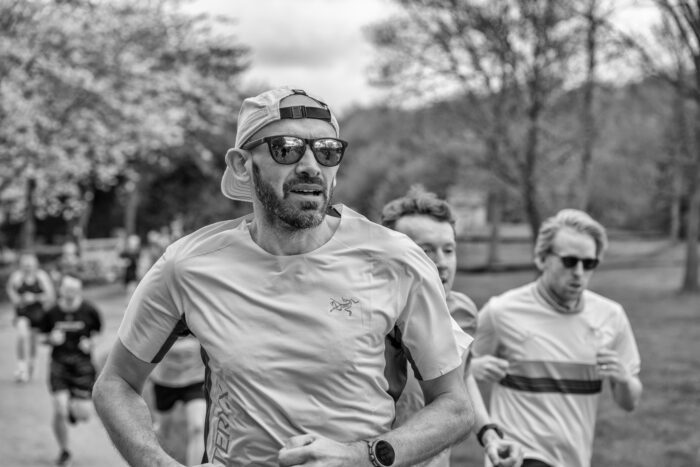
I’d be lying if I said I’m suddenly going to become brilliant at all of these things – but then I know from experience that there’s power in small choices. Over the past few years I’ve improved my diet, been more dilligent with getting enough rest, and tried to incorporate more strength and conditioning, and my last race was probably my best performance to date.
While waking up a different person tomorrow is unlikely, taking on board the advice from the book and introducing better habits and choices will have an effect over time. And if each of those choices helps contribute not only to better running performance but also better quality of life, that has to be a win. So often in life our choices become a cycle, it’s up to us if we make it a virtuous one or a vicious one.
I’d definitely recommend reading Run Forever, for any athlete who wants to build a sustainable active lifestyle and continue doing what they love. You can buy your copy direct from the Vertebrate website, or from good bookstores.
I’ll leave you with a quote from Alex Hutchinson:
“You don’t train less because you’re getting old. You get old, to a surprising extent, because skipping that long Sunday run with your pals becomes a habit instead of a rare exception. Don’t do it.”
-Alex Hutchinson
Thanks to Vertebrate Publishing for providing a complimentary copy of this book. All opinions are my own.